

For farm families, business owners, and high‑net‑worth households, giving is deeply personal, which is why establishing a private foundation is as much a values decision as it is a legal and financial one.
When clients ask us how much they should (or can) give, we flip the script. As wealth grows, the focus often shifts from generosity alone to building a meaningful legacy through structured stewardship that is organized, sustainable, and reflects the family’s unique ethos.
The process typically takes several months and involves legal, wealth management, and ongoing administration. For that reason, a private foundation generally makes the most sense where there is a meaningful pool of capital (often seven figures or more) and a genuine desire for multi‑year or multi‑generational philanthropy.
What Is a Private Foundation?
In Canada, a private foundation is one of three categories of registered charities recognized by the CRA, alongside charitable organizations and public foundations. It is typically funded and governed by a single family or a closely related group of owners.
Within a high‑net‑worth family’s broader wealth structure, the foundation can function as a “philanthropy holding company” that sits alongside the operating company, family trust, holding company, or farm corporation.
Under the Income Tax Act and CRA guidance, a charity is designated as a private foundation if:
a. 50% or more of its directors, trustees, or similar officials do not deal at arm’s length with each other, or
b. More than 50% of its funding comes from a person or group that controls the charity or comprises more than 50% of its directors/trustees.
In practical terms, a private foundation:
• Holds and manages an investment portfolio
• Issues official tax receipts to donors
• Makes grants to qualified donees and, in certain circumstances, to other organizations under qualifying disbursement rules
• Operates under strict legal rules to serve public charitable purposes and prevent undue private benefit
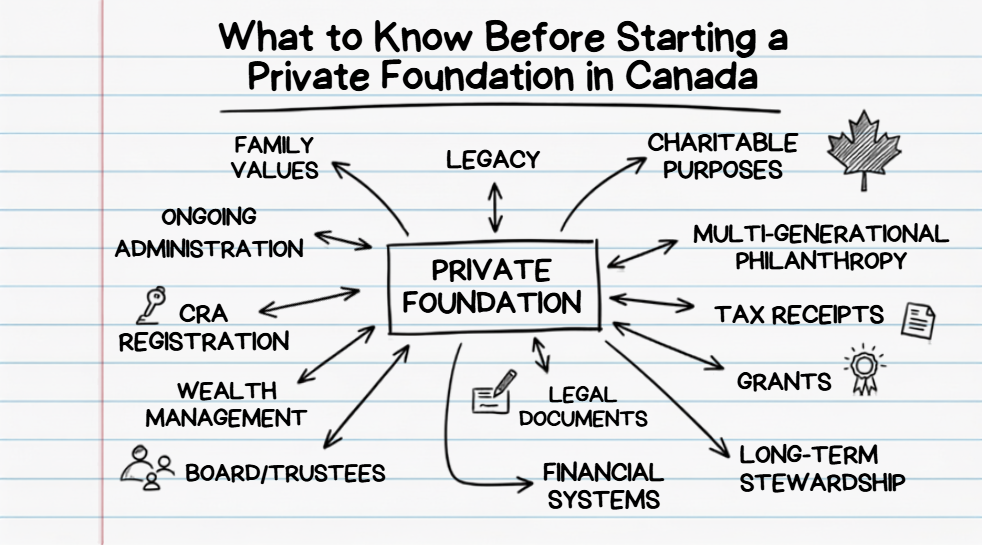
Steps to Establish a Private Foundation
Step 1: Choose Your Incorporation Option
Your first structural choice is whether the foundation will be created as:
• a non-share capital corporation (federal or provincial), or
• a charitable trust established by deed or will
Most affluent families and businesses favour a corporate structure because:
• Directors can be added or removed over time as family roles evolve
• Governance mirrors what you already know from your operating companies
• Board processes (meetings, minutes, resolutions) are familiar and scalable
Trusts can work well where the founder wants more rigid terms or they plan to build the foundation primarily through their will.
Step 2: Prepare Governing Documents
Once you have selected your structure, the next step is to design your foundation’s rulebook. This is where you translate your family story into legal language: the types of causes you want to support, whether the foundation is intended to last indefinitely or wind down over time, and how decision‑making will be shared between generations.
Strong governing documents balance flexibility for future directors with enough structure to ensure your family’s intentions are clearly reflected and protected.
For a corporation, this typically includes:
• Articles of incorporation that set out charitable purposes acceptable by the CRA
• Bylaws that define board composition, voting procedures, quorum, officers, and meeting requirements
For a trust, this typically includes:
• A trust deed that establishes the charitable purposes, outlines the powers of the trustees, and describes how capital and income may be applied to support those purposes
Step 3: Establish Your Board
The initial board or group of trustees will usually be made up of:
• Founders and key family members
• Possibly a trusted advisor (lawyer, accountant, wealth or investment manager)
• Occasionally an independent director with cause or community expertise
From CRA’s perspective, the board’s primary responsibility is to steward charitable assets for public benefit and ensure compliance with the Income Tax Act and related guidance. From a family perspective, the board is also the table where values, money, and legacy intersect.
Step 4: Apply for Charitable Registration
With structure and governance documents in place, you apply to CRA for registration as a charity.
You will generally need to provide:
• Incorporation documents or trust deed
• A description of your charitable purposes and planned activities
• An outline of how you will fund the foundation and make grants
• Details about directors or trustees and any non-arm’s-length relationships
CRA will determine whether your purposes are charitable in law and whether your structure fits the definition of a private foundation (funding and control primarily from a single source or related group).
Step 5: Set Up Financial Systems
Once CRA approval is granted and registration is in place, you can:
• Open bank and investment accounts in the foundation’s name
• Implement accounting and reporting systems
• Establish processes for tax receipting, grant approvals, and ongoing monitoring
BOTTOM LINE
At SANDSTONE Asset Management, we architect what our clients are trying to make possible. Holistic wealth management means seeing the entire picture, i.e., your business, your family, your tax position, and your philanthropic ambitions.
We coordinate with your existing independent advisory relationships (accounting, legal, etc.) to remove financial complexity, so that wealth, tax, and giving remain aligned and intentional. If you are considering starting a private foundation in Canada, we would be pleased to start the conversation over coffee and explore the possibilities.
Markets are uncertain. Your strategy shouldn't be.
Find confidence during confusing times by meeting with one of our wealth professionals.