
Exchange-traded funds (ETFs) – a basket of securities like stocks or bonds that is traded on a stock exchange like a regular company share – have become a huge part of the market. (Watch our latest Sandstone Speaks for more on ETF flows.) Yet, the majority of investors don’t know what drives their liquidity. Do you?
This insight recently came across our desk, and we thought it was an interesting share. In ETF.com's survey on what drives ETF liquidity, only 27.6% of respondents identified the correct answer: underlying holdings liquidity. That means nearly three out of four got it wrong, with most pointing to average daily trading volume as the primary driver.
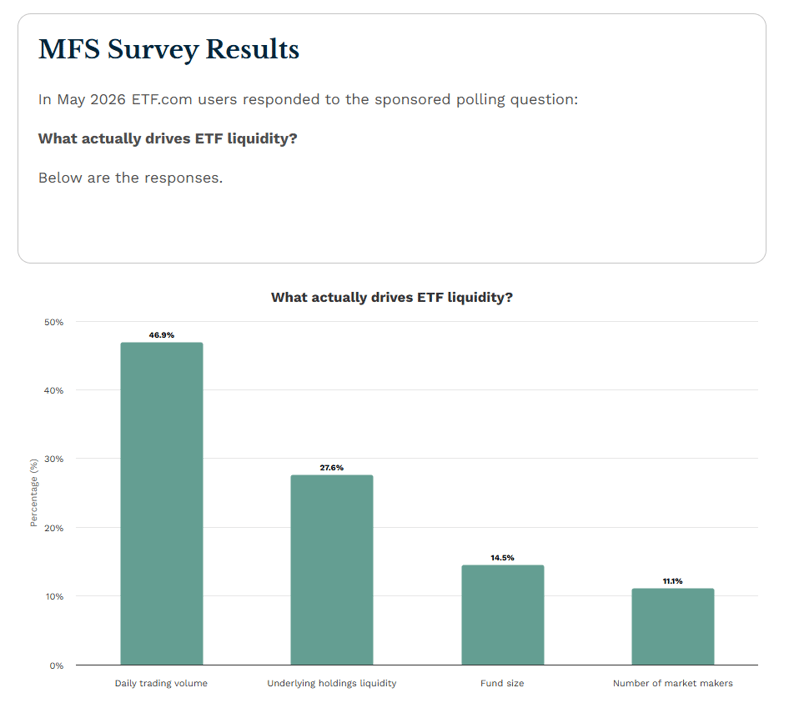
Survey source: https://www.etf.com/
ETF liquidity refers to how easily you can buy or sell shares at a fair price without meaningfully moving the market. A highly liquid ETF lets you transact efficiently, while less liquid ETF can indicate a limited supply of or difficulty in trading the underlying securities.
Looking only at an ETF’s trading volume doesn’t tell the whole story. What matters more is the liquidity of what the ETF actually holds. For example, an ETF tracking large-cap Canadian equities, where the underlying stocks trade in high demand, carries liquidity even if the ETF itself sees modest daily volume.
In other words, the ETF "wrapper" does not define the risk. Understanding what sits inside an ETF, and how easily those underlying securities can be traded, is where your exposure lies. This may become particularly relevant in periods of market stress, when liquidity can dry up quickly in underlying securities.
BOTTOM LINE
Investor education is central to what we do at SANDSTONE. As Sharon Watkins and Brent Pickerl have discussed in Sandstone Speaks, ETF flows continue to drive markets in ways that can obscure fundamentals and complicate price discovery. Understanding the mechanics behind those flows, including what actually drives ETF liquidity, is part of being a more informed investor.
Markets are uncertain. Your strategy shouldn't be.
Find confidence during confusing times by meeting with one of our wealth professionals.