

For most of the twentieth century, the politics of energy was a story about oil. While that story is not yet over, it has become much more complicated. We are currently living through the 4th industrial revolution, with massive AI-driven capital expenditures fueling innovation and competition around the world and across all industries. The rise of generative AI is the next frontier in advanced robotics, automation, and the smart devices of the future. While AI harbors immense potential, it will require massive amounts of rare earth metals and other commodities to fuel its development. Today, the energy transition has layered a second contest on top of the first, a race for lithium, cobalt, uranium, and other materials that the world will be scrambling for in order to meet the demands of the economies of tomorrow.
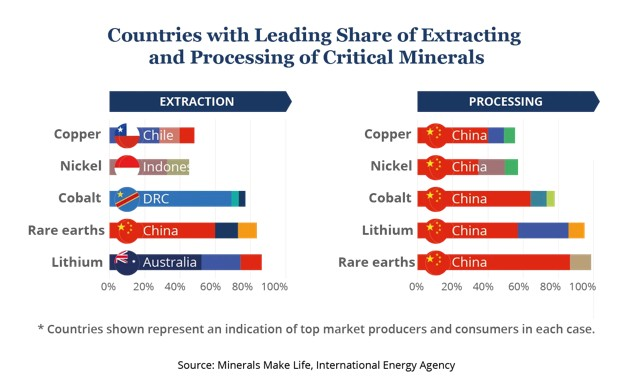
Every solar panel, battery, and electric vehicle depends on a relatively short list of critical minerals. Lithium for battery anodes, cobalt and nickel for cathodes, neodymium for magnets in wind turbine, and enormous quantities of copper for the wiring that stitches it all together. The geographic distribution of these resources is striking. Over 60 percent of the world's lithium sits in the "lithium triangle" of Argentina, Bolivia, and Chile. The Democratic Republic of Congo, a country with virtually no institutional stability, supplies the majority of global cobalt. China controls over 80 percent of rare earth processing capacity, regardless of where the ore is mined. This is a geopolitically fraught supply chain, and the nations that sit atop these deposits are quickly learning just how much leverage they have.
What makes the current situation distinct is the explicit fusion of energy policy with industrial and military strategy. The United States' Inflation Reduction Act, the European Union's Critical Raw Materials Act, and China's ongoing dominance of solar panel and battery manufacturing are clear expressions of strategic competition. Governments have concluded that dependence on a rival for the inputs to fuel your country is a national security issue and they are willing to intervene economically and even militarily in order to achieve their goals. The military dimension is less discussed but increasingly relevant. Rare earth elements are embedded in precision-guided munitions, radar systems, and advanced communications hardware. A nation that cannot access these resources cannot manufacture the engines in its fighter jets or the scanners in its hospitals. The Pentagon's designation of critical minerals as a defense-industrial priority reflects a genuine vulnerability that has arisen as a result of decades of offshoring.
As evidenced by the closure of the Strait of Hormuz following the American attack on Iran, the immense concentration of key resources in certain regions has meant that countries controlling key trade bottlenecks have the ability to effectively cripple the world economy overnight. Within hours of the closure, oil prices shot up over 50%. Within days, countries around the world began implementing emergency measures to reduce energy consumption and, in some cases, were forced to begin rationing fuel. Flights were cancelled as jet fuel became scarce and countries began to scramble to find alternative ways to keep their economies running. Supply chains that had been optimized for efficiency rather than resilience snapped under the pressure. Shipping costs spiked as vessels were rerouted thousands of miles around the Cape of Good Hope, adding weeks to delivery times and billions in costs to global trade. What the episode made clear is that the world's critical resource flows remain extraordinarily fragile and concentrated through a small number of chokepoints, any one of which, if closed, can transmit an economic shock of systemic proportions within days. The Strait of Hormuz is the most dramatic example, but it is not the only one. The Strait of Malacca, through which the majority of East Asian energy imports pass, represents an equivalently large vulnerability.
Nuclear power has also re-entered the strategic conversation in a way that would have seemed implausible just a few years ago. The need for reliable baseload power to complement intermittent renewables, the carbon-free profile, and the development of small modular reactors that reduce the massive capital requirements that doomed the previous generation of plants has changed the calculation. Japan is beginning to restore idled capacity, while many emerging economies are building out nuclear programs with Chinese and Russian assistance.
Uranium supply is as geographically concentrated as lithium. Kazakhstan, Canada, and Australia account for the bulk of production while Russia controls significant enrichment capacity. The spot price of uranium has reflected these tensions and the growing demand, having more than tripled from its 2016 lows.
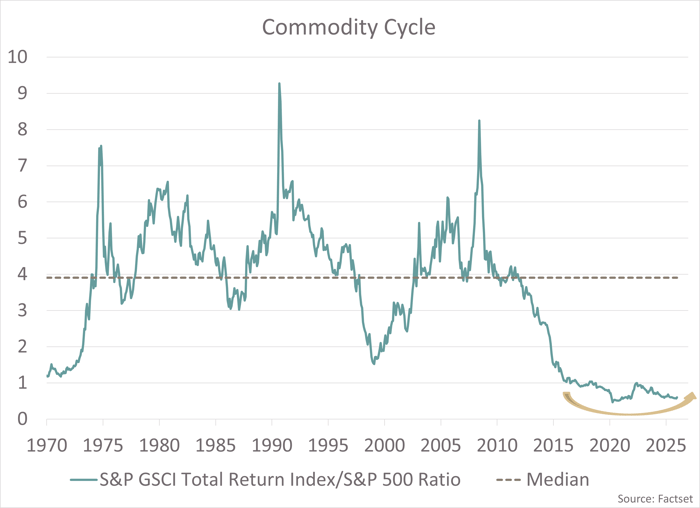
The commodity cycle that underpins this geopolitical story has a direct macroeconomic channel that investors cannot afford to ignore: inflation. The energy transition is, at its core, a massive capital expenditure program layered on top of existing energy demand. Building out solar, wind, battery storage, and the grid infrastructure to support them will require commodities far in excess of current production. The underinvestment in mining, drilling, and logistics capacity over the past decade, accelerated by ESG-driven capital restrictions on extractive industries, has created a supply deficit that is only just beginning to show up in prices.
Central bankers have historically treated energy as an exogenous shock. The energy transition complicates that assumption. If copper and other rare earth metal demand doubles by 2035, as some projections suggest, and with mines taking 10-15 years to get up and running, the inflationary shock could become a persistent structural feature rather than a transient disruption. The current commodity cycle may end up lasting longer and going higher than it has traditionally due to the secular trends of underproduction and seemingly endless demand. Portfolios that are built on the assumption of a smooth return to the status-quo of 2% inflation will likely underestimate the impact that a growing deficit of critical commodities will have on prices across the economy.
BOTTOM LINE
The energy transition will happen. But it will not happen cleanly, cheaply, or without conflict. The nations and companies that control the physical inputs to that transition will wield outsized influence, and the investors who recognized that early will look, in retrospect, to have understood something that the market was slow to price.
Markets are uncertain. Your strategy shouldn't be.
Find confidence during confusing times by meeting with one of our wealth professionals.