
The U.S., long the undisputed anchor of the global financial system, has entered a period of political volatility and policy unpredictability that has caused investors around the world to reassess many of their long-held beliefs about the perceived sanctuary of American capital markets. The weaponization of the U.S. dollar through sanctions, the use of trade tariffs as tools of negotiation, and the growing fiscal concerns around U.S. debt sustainability have eroded the assumption that American assets are a universal safe haven (this is something we have discussed at length over the past decade, you can read more here and here).
In today’s environment, capital no longer automatically moves towards one jurisdiction in times of panic. Money flows are undergoing a more nuanced reallocation toward assets that are real, scarce, and strategically important. We witnessed this over the past few years as investors and central banks started piling into gold following the U.S. decision to seize Russian foreign currency reserves and kick them off the global payment system in 2022 (we were bullish on gold well before most investors were, you can read more here). Following the closure of the Strait of Hormuz, we saw the expected flows into energy stocks but also considerable movements into alternative energy, construction and infrastructure and away from intangibles like financial and software companies.
Today, Canada stands at an inflection point. Geopolitical turmoil, the realignment of global trade and the shifting balance of power could serve as a generational opportunity for us to attract some of this capital and revitalize our economy. For the past few decades, we have not fully lived up to our potential due to a combination of under-investing in ourselves and short-term thinking. The stagnant economic growth that this led to is not something that can be laid at the feet of any one particular party or leader, it is a secular trend that has accumulated from successive policy mistakes, inactions and a changing collective mindset that tolerated the quiet erosion of Canadian companies and the departure of our most ambitious people.
Between 2008 and 2013, the average number of public stock listings (IPOs) was 47, but this dropped to 16 between 2014-2024 and to just three in 2025. Meanwhile, 54 companies were delisted or taken private in 2025 alone, with over $125 billion leaving the TSX since 2023. Critically, most of these transactions were not between domestic companies, but were takeovers or sales to foreign firms that often relocated their head offices, taking high-paying jobs with them. While the trend has been negative, it isn’t irreversible. There are indications that activity is picking up again in 2026 with several companies already announcing their intention to go public. The importance of a company choosing to stay and grow on Canadian soil is not abstract. A key example is Shopify, which stayed rooted in Canada rather than following the well-worn path to Silicon Valley like many of its peers.
Their intentional decision to keep their headquarters in Ottawa has since generated billions in GDP, indirectly and directly supported over 150,000 jobs, and anchored an entire ecosystem of entrepreneurs, engineers, and investors who might otherwise have followed the company south. Canada does not need a hundred Shopifys, but it desperately needs to stop making it so easy to lose the ones it has.
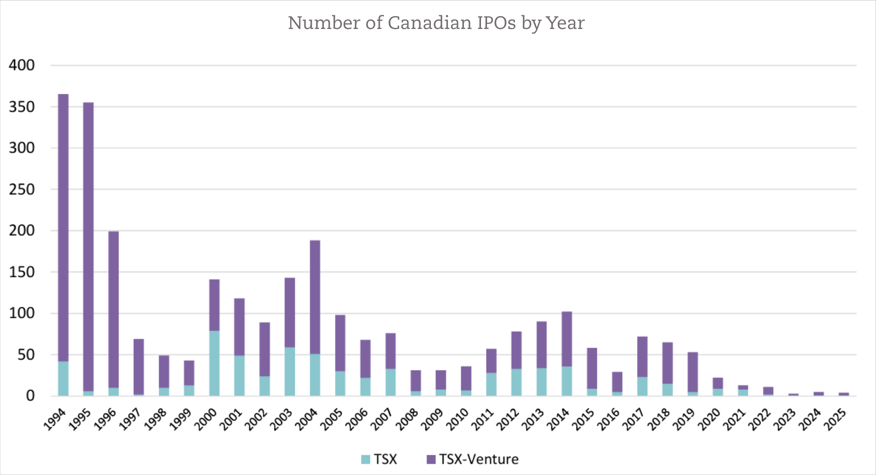
Source: https://site.warrington.ufl.edu/ritter/files/IPOs-Canada.pdf
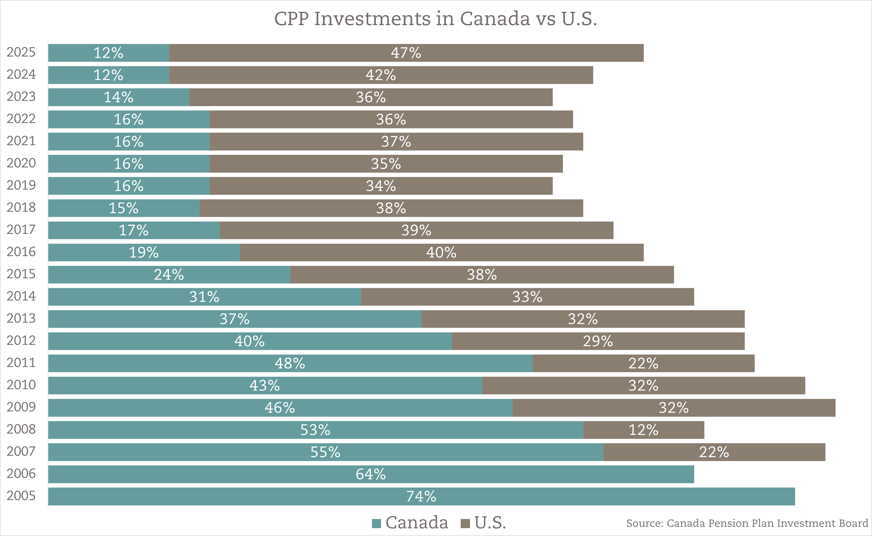
Aside from public markets, Canada has another underutilized source of capital that could help revitalize the economy. Our collective Federal and Provincial pension funds manage over $2.5 trillion in assets, yet an increasingly small proportion of those dollars are invested domestically. The share of the CPP’s domestic investments fell from 74% in 2005 to just 12% in 2025, while the U.S. share ballooned to 47%. The greatest area of alignment between pension fund capital needs and Canada’s structural investment deficit is infrastructure. Long-duration assets such as transit systems, energy networks, water infrastructure, and broadband match the liability profiles of pension plans while providing much-needed domestic investment that would make our economy more competitive and prepared for the technologies of tomorrow.
Another area where pension plans could play a more active role is in financing private companies. Growing private companies that are too large for venture capital firms but not quite ready to go public often struggle to find the long-term capital they need to expand sustainably. By providing a stable source of funding for these types of companies, we could reduce the trend of business owners feeling “stuck” and choosing to sell to a foreign firm rather than continuing to grow domestically.
While some of our past decisions and indecisions may not have been perfect, our opportunities remain limitless. Unlike many economies that are attempting to build their own niche and competitive advantage from scratch, we have already done the work. Our human capital is unmatched with one of the most highly educated populations in the OECD and an immigration system that attracts the most talented people from across the world. We are also home to a natural resource endowment that is unparalleled in size and scope with some of the world's largest proven reserves of oil, natural gas, potash, lithium, nickel, copper, and other critical minerals that are essential to the energy transition and to keep modern industrial supply chains running.
BOTTOM LINE
The question is not whether Canada can become a great investment destination. The question is when investors will recognize that it already is one, and whether the institutions, policies, and mindset exist to realize our capabilities. We have a history of identifying our potential without fully realizing it, allowing ambitious projects to be captured by regulatory process or political conflict. To attract capital back to our country we will need a coordinated and sustained commitment to making Canada the kind of economy that capital trusts, that talent chooses, and that entrepreneurs want to build in. We have the resources. We have the people. All we need now is the collective will to build.
Markets are uncertain. Your strategy shouldn't be.
Find confidence during confusing times by meeting with one of our wealth professionals.