

The AI boom is just the next iteration of the all-too familiar story. A disruptive new technology comes out, and companies become willing to spend seemingly infinite amounts to try and come out on top. Valuations are high, capital expenditure is enormous, and the eventual winners should in-theory generate extraordinary returns. However, the deeper story is about concentration. A small handful of companies are becoming ever-increasingly large parts of our economies, markets and daily lives, yet very few people seem to be paying attention to the potential implications.
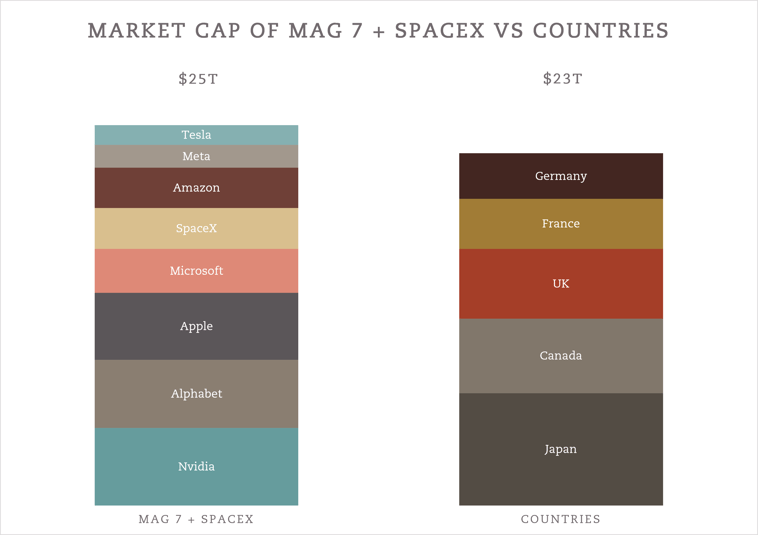
Source: FactSet (countries). A previous version of this chart appeared before SpaceX had its IPO on June 12. The company has since overtaken the market cap of Amazon and Microsoft.
Google's dominance of the information layer was far more than just a business triumph; it gave it direct control over the types of information that would be distributed and to whom. A narrative that Google's algorithm did not surface struggled to gain traction. Companies that weren’t early on in search results effectively ceased to exist to most consumers. AI is concentrating this chokepoint further.
The shift from manual research to AI-generated answers reflects a fundamental change in where editorial authority sits. When a user receives a list of links in a Google search, the agency remains on them to evaluate, compare, and cast doubt on the information that was provided. When a user receives an answer from a language model, that agency has been largely transferred to the AI. The model decides what to include, how to frame it, whose sources to weight, and what to leave out. It funnels ideas, research and analysis into a condensed format that strips it of context and reduces the need for critical thinking. By outsourcing this process to AI, ideological diversity and independent thought are being replaced with model-driven narratives and groupthink.
This shift in authority is not occurring in isolation; it is being paired with a growing concentration of control over the systems that produce these answers. As a result, it is creating a new kind of systemic fragility: biases basked into a model no longer affect a single user or company, they affect every user simultaneously, in the same direction.
Historical Precedents
• The printing press concentrated authority in the hands of a small number of institutions and state-backed publishers, intensifying religious and political conflict across Europe before eventually becoming decentralized.
• The telegraph handed enormous informational power to the few firms that could afford to build and maintain national networks, before regulation and competing technologies gradually reduced that dominance.
• Broadcast television followed a similar arc, concentrating cultural and political influence in a small number of networks before cable, deregulation, and digital media weakened control.
RISKS
The major risk that is arising because of the AI boom is the homogenization of thought. Markets function largely because participants hold differentiated views about the future. When those participants increasingly form their views by querying the same small set of models that are trained on the same data and tuned toward similar objectives, the ideological diversity that makes price discovery meaningful begins to erode. There is early evidence from AI-assisted financial analysis that suggests that large language models (LLMs) tend to reinforce existing views rather than challenging them. In a market context, that is precisely the wrong property to want.
This is not to say that AI doesn’t serve a purpose in markets, but rather that most investors are not using it correctly. AI can find and compile explicit knowledge faster than any human can, but that knowledge is devoid of the context that makes the data inherently useful. When used as a compliment to human judgement and analysis, AI can be immensely beneficial. However, it fails as a substitute since it cannot generate new or unique ideas, but rather simply repackages existing knowledge into a new format.
As active managers become more reliant on AI for decision-making, and as more capital flows into passive investment vehicles, companies with the loudest narratives are becoming increasingly driven by momentum and trends, rather than fundamentals. This is not sustainable, as valuations can only diverge so far from underlying reality before reverting, often abruptly, to the mean.
BOTTOM LINE
Instead of following the crowd and chasing increasingly stretched valuations, at SANDSTONE we are making tactical decisions to trim profit when prudent and increase exposure to areas with long-term value, rather than short-term fluctuations. In this type of environment, strategic thinking, patience and independently derived investment theses will be the key to differentiating between the investors that will succeed and those that will get caught up in the end of a trend. As Wayne Gretzky once said, “skate to where the puck is going, not to where it has been”.
Markets are uncertain. Your strategy shouldn't be.
Find confidence during confusing times by meeting with one of our wealth professionals.