

In periods of heightened market and geopolitical turbulence, investors are often tempted to over-analyze every headline and react to each intraday swing. At SANDSTONE, we take the opposite approach. Rather than attempting to decode the noise of every market move, we combine disciplined patience with proactive execution to ensure that we always remain in a strong position.
Our approach is centred on high-conviction, active management. We are not simply "holding on” but are actively optimizing our portfolio. Through our tactical rebalancing, we have reached a significant milestone for several of our core holdings, the full recovery of our initial cost basis.
By harvesting gains as prices hit our internal targets, we have received 100% of our original capital back on these investments. Mathematically, this means the remaining shares we hold in these companies now have a cost basis of zero. We continue to maintain full exposure to their long-term growth and dividends, but we are doing so using only the profits generated by the market. This has fundamentally reduced the risk of our portfolio and allows us to stay invested in high-quality companies with the peace of mind that our initial principal is safe and sidelined, ready to be deployed into the next opportunity.
Another key pillar to our strategy is our increased allocation to cash and liquidity. Maintaining a higher cash buffer allows us to bypass the pressure of forced selling and instead operate from a position where we can make decisions on our timeline, rather than have the market dictate it for us. We are closely monitoring a list of high-quality companies that we believe have strong long-term prospects, but whose valuations are currently too high. Our cash allocation gives us the flexibility to act on these opportunities when they hit the right price while also reducing the portfolio’s overall volatility. While we remain patient, we are simultaneously scouring the broader landscape for new prospects that may arise out of an ever-changing situation.
Over the past few weeks, we have also observed a breakdown in gold’s traditional role as a hedge. Similar to how rising ETF allocations have begun to mute traditional market signals, the sharp correction in gold highlights yet another 'artificial' aspect of modern markets. This recent downturn was largely driven by the sheer volume of paper gold (futures contracts), which dwarfs the actual physical supply of gold.
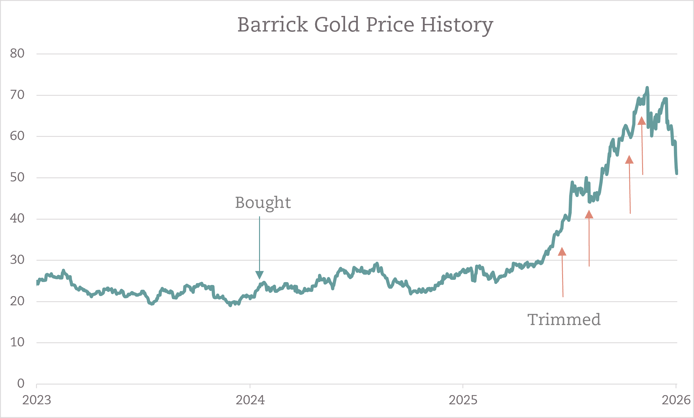
In times of broad market stress, institutional investors often face margin calls on losing positions. To cover these, they may be forced to exit, which puts further downward pressure on the price and triggers more margin calls. This mechanical selling, rather than a shift in fundamental belief in the metal, explains much of the recent drop in gold prices even as geopolitical and economic uncertainty rises. It is in situations like this where active management proves particularly beneficial. As gold was rising throughout 2025, we took profit 4 times from our position in Barrick Gold, giving us a 141% return while still maintaining some exposure. By making calculated trims, we reduced our concentration risk on the way up and locked in our returns before the downturn.
BOTTOM LINE
While the future is becoming increasingly unpredictable, we believe that having a prudent long-term view can help turn volatility into opportunity.
Markets are uncertain. Your strategy shouldn't be.
Find confidence during confusing times by meeting with one of our wealth professionals.