
The past week may go down as one of the most critically important weeks in recent history, yet equity markets didn’t seem to notice. While the futures market was wildly oscillating, if you were only looking at the energy market indices, you might have missed out on the excitement entirely.
For investors, the shifting sands of headline risk still carry predictable undercurrents. At SANDSTONE, we view this environment through three lenses: money flow, an increasingly concentrated market, and tactical positioning. This framework was immediately put to the test this week as WTI futures became a portrait of volatility.
On Monday, we saw a rapid surge as threats to the Strait of Hormuz, a chokepoint for 20% of global oil supply, sent Brent and WTI toward the $120 mark. Just a few hours later, prices had dropped to $90 following social media-driven optimism for a "quick resolution" to the conflict.
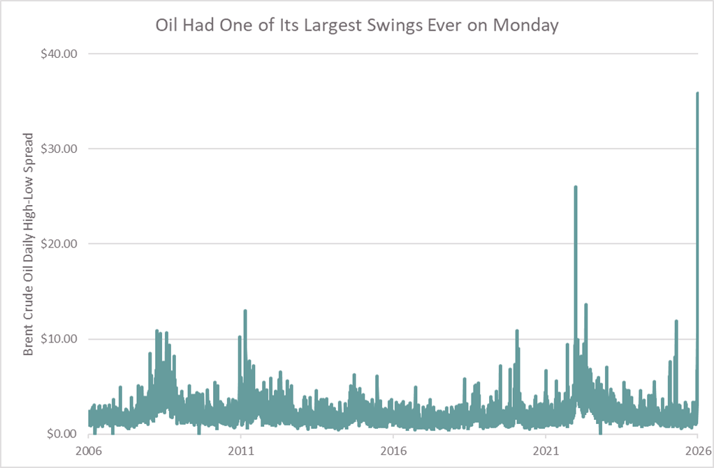
Despite the historic swing in the underlying commodity, energy companies remained remarkably stoic. This "muted" response wasn’t a glitch; it’s the new reality of a market that has become increasingly dominated by passive investors. Over the past decade, passive investing has become increasingly popular, overtaking active managers in market share in 2023 and continuing to grow further since then.
This effect, combined with the growing trend of investors wanting to “buy the dip” anytime the market drops by even a small margin, has meant that prices are being “smoothed out” and are no longer fully reflecting overall sentiment. When money began to flow out of these broad ETFs, it put downward pressure on all areas of the market, including energy. While energy only makes up 3% of the index, it did impact the size of the upward movement in the sector.
This week also highlighted what could be a major change to how investors react to volatility going forward. Historically, military conflicts would trigger a “flight to quality”, where investors would rotate away from emerging market assets, riskier stocks and foreign currencies and into U.S. dollars and treasuries. While investors did move away from Korea and Taiwan, they chose to reinvest their funds in countries like China and in particular Hong Kong, instead of the U.S. We saw treasury yields go up this week, and the dollar saw a slight uptick but failed to break out of its current downtrend. This could suggest that the U.S. may no longer be viewed as the safe haven it once was.
Overall, energy has served its purpose as a hedge with our positions in Shell and Canadian Natural Resources having increased by 23% and 43% since the start of the year. North America is figuring out that this may not just be short-term pain, but rather a major event with long-term implications. This could become America’s own Suez moment. Despite the major disruptions in the markets, our portfolio is up 4% year-to-date, partly due to energy serving its purpose as a hedge. We have deliberately trimmed equity positions into strength, to increase cash to a level that affords both protection and the flexibility to take advantage of new opportunities.
BOTTOM LINE
This portfolio management strategy captures our dual objectives: preserving capital through prudent profit-taking while opportunistically adding exposure where long-term value appears compelling. We view cash as an asset class, not idle ballast. It provides protection amid uncertain valuations, provides a guaranteed income stream, and acts as an effective hedge against forced decision making. As we have often repeated, the secret to investing is not just what you own, but what you pay. Long-term thinking, risk management, and strategic patience remain our compass in an otherwise erratic world. The coming months may continue to deliver volatility, but disciplined capital allocation will continue to transform change into opportunity.